Key points at a glance
- Tischler (joiner) belongs to the combined craft under § 94 no. 71 GewO. Besides the master craftsman exam, the access regulation also recognises HTL (technical college) and university of applied sciences degrees with practical experience.
- A workshop with machines is almost always a Betriebsanlage requiring a permit (commercial facility, § 74 and § 77 GewO). Clarify zoning and the permit before you sign the lease.
- Hardwood dust is carcinogenic. An EU-wide limit of 2 mg/m³ applies to it; you can't do without effective extraction on every machine.
- Your own CNC only pays off with high utilisation. For the start, cutting at the panel dealer or contract machining by fellow joiners is often more economical.
- Calculate with machine hour rates and separate installation hours, not with one single flat rate.
This article is general information, not legal or tax advice. Rules change: check the details with your economic chamber or chamber of crafts, your trade guild or your tax adviser.
The licence: joiners in the combined craft
§ 94 no. 71 GewO combines "Tischler; Modellbauer; Bootbauer; Binder; Drechsler; Bildhauer" (joiners, model makers, boat builders, coopers, wood turners, sculptors) into one combined craft. For furniture, interior fit-out, doors and windows, you register the trade "Tischler". For joiners, the access regulation (Federal Law Gazette II no. 91/2003) is more open than for many building trades, because it expressly recognises school-based routes:
| Education | Also required |
|---|---|
| Master craftsman exam | nothing; the master exam includes the entrepreneur exam |
| University of applied sciences degree in interior design and wood technology | at least 1 year of work in the field |
| HTL in interior design and wood technology, or art and design with a craft focus | at least 1.5 years of work in the field |
| Werkmeisterschule (foreman school), master school or technical academy for joinery | entrepreneur exam and 2 years of work in the field |
| Apprenticeship certificate in joinery | followed by several years as a self-employed person, business manager or in a senior position |
If you meet none of these routes, you can apply to the trade authority for the individual proof of competence under § 19 GewO or appoint a qualified gewerberechtliche:r Geschäftsführer:in (managing director under trade law, § 39 GewO). For some activities you don't need the full licence at all: assembling furniture kits is a free trade under § 162 GewO. That is enough for assembly services, but not for made-to-measure furniture.
The workshop: operating permit, noise and dust
A panel saw, edgebander, extraction system and compressor turn a hall into a Betriebsanlage within the meaning of § 74 GewO. It needs a permit if it can disturb neighbours through noise, dust or odour or endanger employees, which is practically always the case for a joinery. Smaller facilities are often approved in the simplified procedure under § 359b GewO, which is considerably faster.
Check the zoning
Ask the municipality whether the property is zoned for a joinery. In residential areas, a workshop with machines is usually hard to get approved; business or commercial zones are easier.
Preliminary meeting with the authority
The Bezirkshauptmannschaft (district authority) or Magistrat (city council) offers project consultation days. Bring a floor plan showing the machine layout, extraction, spraying area and storage.
Application documents
Description of operations, list of machines with sound power levels, plans, ventilation and extraction concept, fire safety and waste concept. A planner with experience in commercial facilities saves months here.
Hearing and decision
In the ordinary procedure, there is an oral hearing with neighbours and experts. The decision (Bescheid) contains conditions, such as operating hours or noise protection measures. Comply with them and document it.
Wood dust: limit value, extraction, respiratory protection
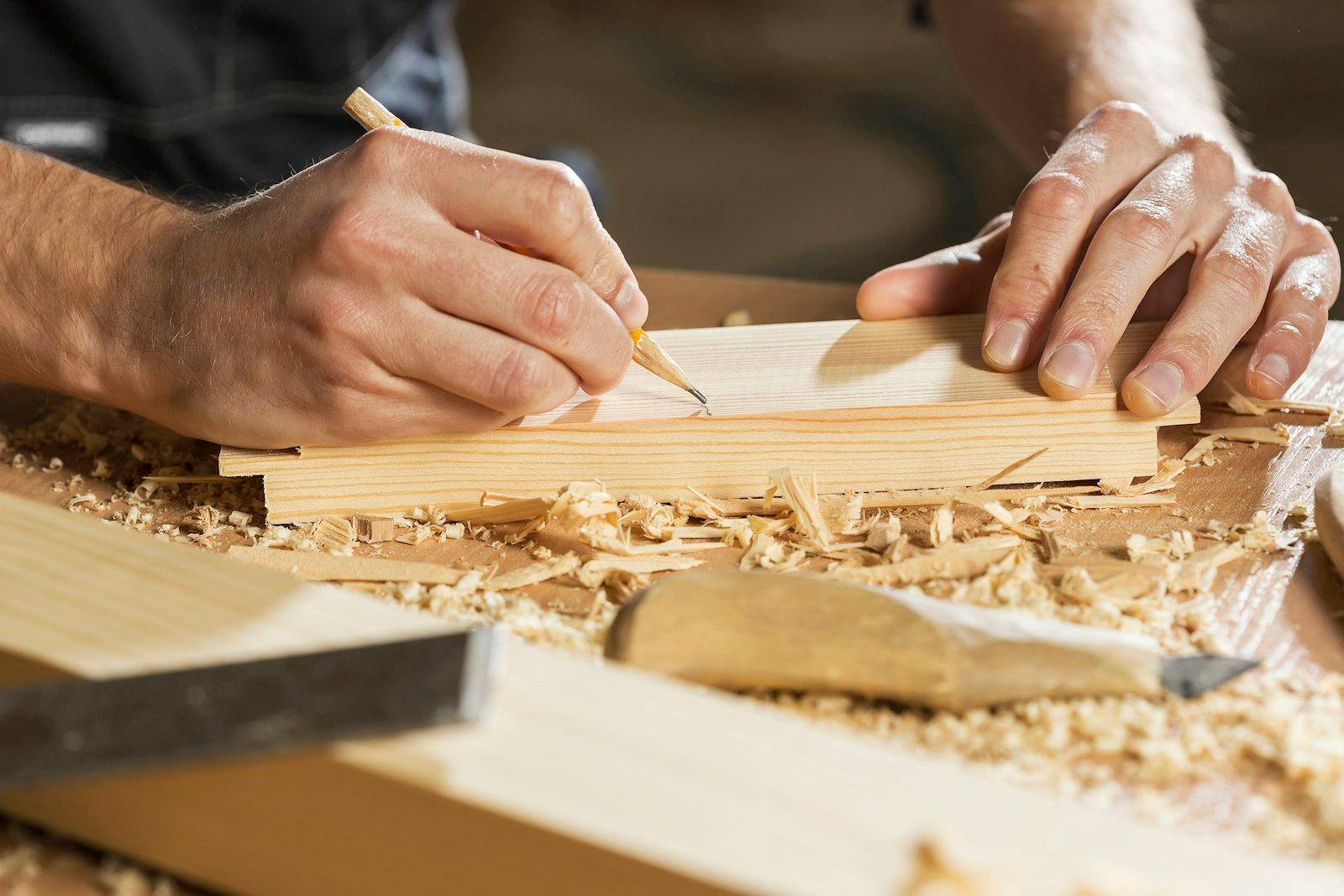
Dust from hardwoods such as oak and beech is classified as carcinogenic. Since 2023, an EU-wide occupational exposure limit of 2 mg/m³ has applied, implemented in Austria through the Grenzwerteverordnung (Limit Values Ordinance). For you as an employer this means:
- Every dust-producing machine gets extraction that suits the machine; hand-held machines work with a dust extractor.
- Sweeping and blowing off with compressed air are off limits; clean with an industrial vacuum cleaner.
- In your workplace risk assessment, you describe wood dust, noise, varnishes and machines. The AUVA (accident insurance institution) supports businesses with up to 50 employees free of charge through AUVAsicher.
- Shavings and dust are flammable. The extraction system, silo and filters belong in your fire and explosion protection concept.
Buy a CNC or outsource?
A CNC machining centre is the dream of many founders. Do the maths soberly: a new machine for panel processing costs around €100,000 to €300,000 depending on equipment; used machines are available from about €40,000. Add software, training, foundation, extraction and maintenance. The alternative: you have panels cut and edged at the dealer, or buy CNC hours from a friendly joinery.
| Criterion | Own CNC | Cutting and contract machining |
|---|---|---|
| Investment | high, plus running costs | low |
| Utilisation | only pays off with regular series or carcass production | flexible, you only pay for what you need |
| Lead time | you set it yourself | depends on the partner, often a few days |
| Know-how | CAD/CAM skills needed in the team | handing over data is enough |
| Risk | downtime and loan payments continue in quiet months | low |
A proven order: start with a panel saw, edgebander and cutting at the dealer, watch what kind of jobs come in, and only invest once you would keep the machine busy three to four days a week.
Installation at the customer's: standards and CE
In interior fit-out especially, installation decides whether the customer is satisfied. Contractually, the contract standard ÖNORM B 2217 (building joinery work) helps if you agree it. For installing windows and doors in walls, ÖNORM B 5320 describes planning and execution of the joints. If you make windows or external doors yourself, you need a declaration of performance and CE marking under the product standard EN 14351-1. Many small businesses use the test certificates of their hardware or system supplier for this.
Pricing, using a built-in wardrobe as an example
A customer job: built-in wardrobe under a sloping ceiling, 3.2 m wide, carcass made of coated chipboard, lacquered fronts. The values are assumptions for illustration:
| Item | Basis | Amount |
|---|---|---|
| Materials | Panels, edging, fittings, lacquer incl. 15 % offcuts | €1,450 |
| Planning and measuring | 4 h at €68 | €272 |
| Workshop | 16 h bench work at €64 plus 6 machine hours at €85 | €1,534 |
| Lacquering fronts | 5 h at €64 | €320 |
| Installation | 2 people, 7 h each at €62, plus travel | €940 |
| Total | €4,516 plus risk and profit of about 10 % | about €4,970 |
The most important point: separate workshop, machine and installation hours. A machine hour carries depreciation, electricity and maintenance and is more expensive than a bench hour. If you calculate everything with one average rate, you earn too little on machine-intensive jobs.
How to get it right
- Clarify zoning and the operating permit before signing the lease
- Plan extraction together with the machines
- Calculate machine hour rates separately
- Collect reference photos of finished kitchens and fitted furniture, with your customers' consent
Better not
- Financing a CNC before your order book can carry it
- Working with machines in a garage without a permit
- Selling windows without a declaration of performance
- Including installation as a flat "won't take long" item
Show your work
Within 3 days we build you a free draft of your joinery website with a project gallery and enquiry form.
A free draft of your future business website.
The steps every trade in Austria goes through, from GISA to SVS, are described in Starting a business in Austria. What must appear on your website and letterhead is shown in Mandatory details in Austria. If you are looking for apprentices or journeymen, the post Finding staff will help.
Sources
- RIS – Gewerbeordnung 1994, § 94 (regulated trades)
- RIS – access requirements for Tischler, Modellbauer, Bootbauer, Binder, Drechsler, Bildhauer
- RIS – Gewerbeordnung 1994, § 74 (commercial facilities)
- RIS – Gewerbeordnung 1994, § 77 (permit)
- RIS – Gewerbeordnung 1994, § 359b (simplified procedure)
- RIS – Gewerbeordnung 1994, § 162 (free trades)
- RIS – Gewerbeordnung 1994, § 39 (qualified managing director)
- WKO – list of standards for joiners and wood designers (as of 4/2024)
- AUVA – AUVAsicher
- GISA – Gewerbeinformationssystem Austria