Key points at a glance
- Metallbauer (metalworker) is no. 13 in Annex A of the Handwerksordnung (Crafts Code). Without entry in the Handwerksrolle (register of crafts), you may not run the craft as a self-employed business.
- Load-bearing steel or aluminium components need CE marking under EN 1090-1. For this, you have your factory production control certified and designate a welding coordinator.
- Your employers' liability insurance association (Berufsgenossenschaft) is the BGHM (wood and metal). Register within one week of starting the business.
- Railings are governed by the Landesbauordnungen (state building codes): under the model building code usually at least 0.90 m high, 1.10 m from a fall height of 12 m, and 1.00 m in workplaces.
- Power-operated gates are machinery. From 20 January 2027 the new EU Machinery Regulation applies to them; maintenance and annual inspection are a line of business of their own.
This article is general information, not legal or tax advice. Rules change: check the details with your economic chamber or chamber of crafts, your trade guild or your tax adviser.
The market: who buys metalwork?
A typical small metalwork business stands on three legs. Private customers want balcony railings, yard gates, fences, canopies and external stairs, often for a new build or after buying a house. Building firms and developers need stairs, steel beams, fall protection and escape stairs. Commercial customers and property managers pay for gate maintenance, repairs and small alterations. Margins are best with private customers, volumes are biggest with developers, and maintenance evens out the seasons.
| Product | Key requirements | Note for pricing |
|---|---|---|
| Balcony and stair railings | State building code (height, openings, protection against climbing), load assumptions | measure on site, check fixings in existing structures |
| External and spiral stairs | DIN 18065 (rise, going, flight width), EN 1090 where load-bearing | structural calculations often bought in |
| Canopies, balconies, carports | EN 1090-1 with CE marking, structural calculations, building permit if needed | certification is a prerequisite |
| Power-operated gates | EN 13241 (product standard), machinery law, inspection under ASR A1.7 | offer a maintenance contract at the same time |
| Fences, handrails without a fall protection function | few formal requirements | a good start, quick references |
Meisterpflicht and the Handwerksrolle
Metalworker training covers the specialisms of structural engineering, metal design and commercial vehicle construction. For self-employment, though, only entry in the Handwerksrolle counts, and these are the routes:
- Master craftsman exam in the metalworking craft (four parts: practical skills, technical theory, business and law, vocational and work pedagogy). Many people take parts III and IV in advance.
- Equivalent qualifications under § 7 (2) HwO, such as an engineering degree in mechanical or structural steel engineering, or state-certified technician in a suitable field.
- Operations manager (Betriebsleiter): an employed master metalworker takes on technical management.
- Ausübungsberechtigung (practice authorisation) under § 7b HwO: journeyman's exam and six years of work in the craft, four of them in a senior position, for example as installation manager or workshop supervisor without the title.
- Ausnahmebewilligung (exception permit) under § 8 HwO, if you can prove your knowledge another way.
EN 1090: the step that decides on big jobs
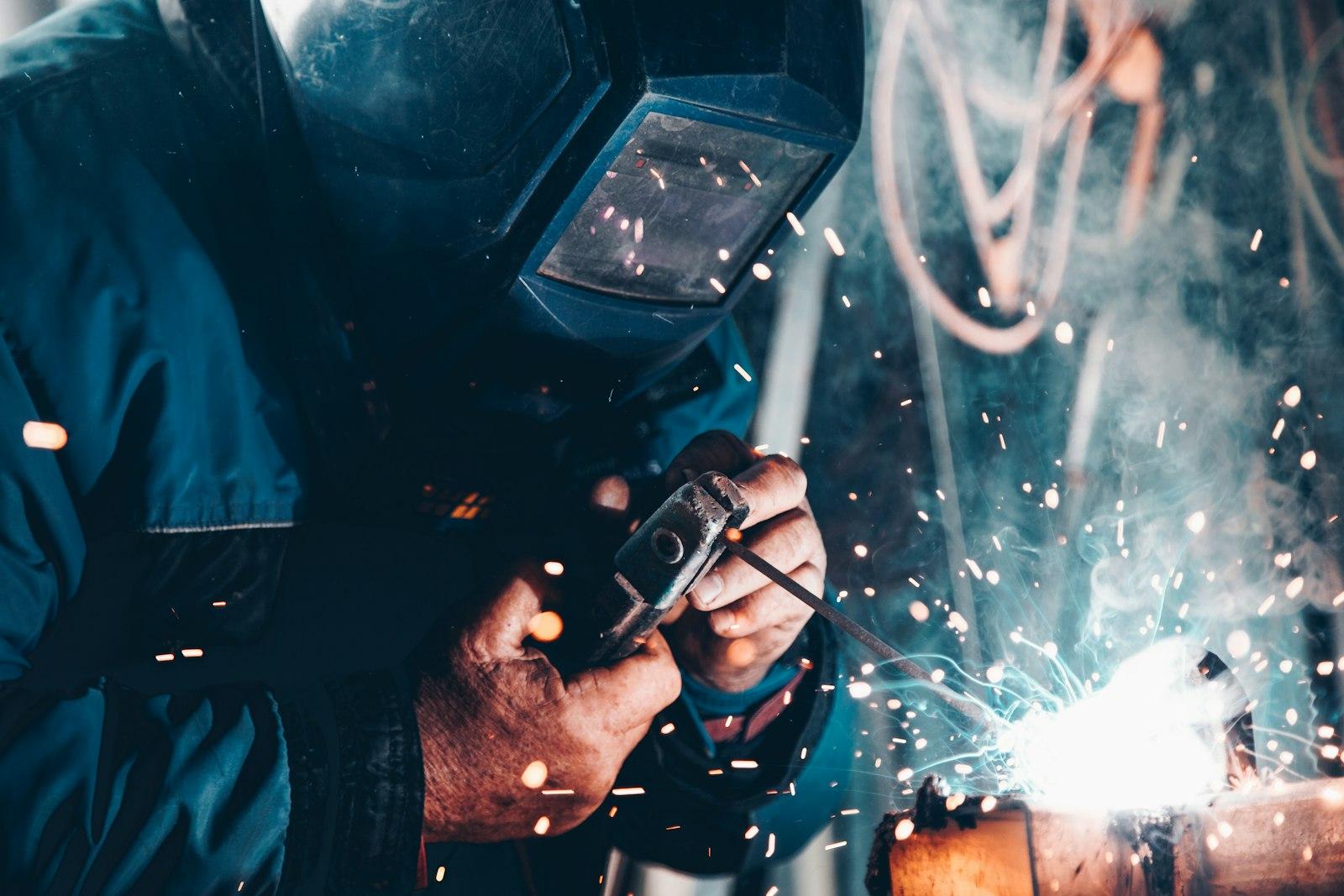
If you manufacture load-bearing components from steel or aluminium, EU construction products law requires you to issue a declaration of performance and mark the component with CE. The basis is the harmonised standard EN 1090-1. The new Construction Products Regulation (EU) 2024/3110 has applied since 8 January 2026 and is gradually replacing the old regulation. For metalworkers, EN 1090 remains the benchmark during the transition period. The execution class (EXC1 to EXC4) is set by the structural design. For most work in building construction, meaning canopies, platforms, balconies and halls, EXC2 is required.
Choose the execution class
Check which components you want to offer. EXC2 covers most building construction. EXC3 rarely pays off for small businesses.
Designate a welding coordinator
For EXC2 with common structural steels and plate thicknesses, a welding coordinator with basic knowledge is often enough, such as an International Welding Specialist (IWS). Thicker plates, higher-strength steels or EXC3 require a Welding Technologist (IWT) or Welding Engineer (IWE). The DVS (German Welding Society) offers courses.
Have your welders qualified
Every welder needs a valid qualification test under EN ISO 9606-1 for the processes and positions used, and under 9606-2 for aluminium.
Set up FPC
Document factory production control: incoming material with inspection certificates, traceability, welding procedure specifications (WPS), procedure qualification records (WPQR), final inspection, measuring equipment.
Get certified
A notified body audits the business, issues the certificate and then monitors it regularly. For the first year, budget roughly €5,000 to €12,000 including consulting and procedure qualifications (guide figures, as of November 2026).
A certificate under EN ISO 3834 (quality requirements for welding) complements EN 1090, and some industrial customers ask for it in addition. You usually do not need it to get started.
Railings and gates: two fields with their own rules
How high a railing must be is not set by a DIN standard but by the state building code. The Musterbauordnung (model building code), which the states follow, requires at least 0.90 m for mandatory guarding up to a fall height of 12 m and 1.10 m above that. In workplaces, ASR A2.1 requires at least 1.00 m. On top of that come requirements against climbing and on opening widths, which are not worded the same way in every state. Read your state's building code and the associated administrative regulation before you fix your standard dimensions. That saves arguments at handover.
Power-operated gates are subject to the product standard EN 13241 and machinery law. From 20 January 2027, the EU Machinery Regulation 2023/1230 replaces the current Machinery Directive. If you build gates with drives, you issue a declaration of conformity, and operators must have the gates inspected by a competent person under ASR A1.7 before first use and at least once a year after that. This inspection and maintenance market is interesting for founders: predictable appointments, repeat customers, good in winter.
Authorities and insurance
Registrations in the right order
- Handwerkskammer: entry in the Handwerksrolle as Metallbauer
- Gewerbeamt: trade registration with the registration certificate
- Tax office: tax registration, USt-IdNr. (VAT ID), exemption certificate under § 48b EStG for installation work on buildings
- BGHM: register within one week, check owner's insurance for yourself
- Employment agency and health insurer: company number, register employees
- Handelsregister (commercial register) for a GmbH: €25,000 share capital, at least €12,500 paid in
If you install railings or stairs on buildings, that counts as construction work. Without an exemption certificate, business clients withhold 15 % Bauabzugsteuer (construction withholding tax), and for subcontracted work for building firms the tax liability may pass to the client under § 13b UStG. The small business scheme (up to €25,000 turnover in the previous year and €100,000 in the current year) rarely suits metalwork, because materials alone make up a large share of turnover. For insurance, business liability including damage to the work, machinery and electronics insurance and contents insurance for the workshop are standard. If you supply EN 1090 components, also consider extended product liability cover.
Two start-up models and what they cost
| Item | Installation business (approx.) | Fabrication with workshop (approx.) |
|---|---|---|
| Van or flatbed with trailer | €30,000 – €45,000 | €35,000 – €55,000 |
| Welding equipment (MAG, TIG) | €3,000 – €6,000 | €8,000 – €20,000 |
| Sawing, drilling, bending, folding | €2,000 – €5,000 (mobile) | €25,000 – €80,000 |
| Welding table, crane, extraction | not needed | €10,000 – €30,000 |
| EN 1090 certification, first year | only if needed | €5,000 – €12,000 |
| Software (estimating, CAD, time recording) | €1,000 – €3,000 a year | €2,000 – €6,000 a year |
Many start as an installation business: they install and repair, have parts cut, folded and galvanised by a contract fabricator, and only build their own workshop once the jobs are there. Others take over an existing metalwork shop whose owner has no successor. That brings hall, machines and customer base in one go, but also old permits that you should check before buying.
How to get it right
- Have the workshop drawing approved before fabrication
- Offer gate maintenance contracts at the point of sale
- Collect photos of every finished railing with material and finish
Better not
- Supply canopies or balconies without CE marking
- Copy railing heights from another federal state
- Use welders with an expired qualification on load-bearing parts
Your work deserves more than an Instagram profile
We build you a free draft of your website with services, references and service area. In three days you see how your metalwork business comes across online.
A free draft of your future business website.
Getting found
Private customers search for specific things: "stainless steel balcony railing", "made-to-measure yard gate", "galvanised external staircase". A website with one page per product group and real photos captures these searches; more on this in the article on local SEO. For developers and architects, what counts is that your EN 1090 class and your contact people are easy to find. Your imprint needs your Handwerkskammer and professional title, see mandatory information for Germany and the imprint generator. What a website costs overall is shown in the article on website costs.
The steps that apply to all trades are in the guide starting a trades business in Germany. If you are looking for staff, the article on finding employees helps.
Sources
- Handwerksordnung, Annex A
- Handwerksordnung, § 7b
- SGB VII, § 192 (duty to register)
- BGHM – Berufsgenossenschaft Holz und Metall
- EStG, § 48 (Bauabzugsteuer)
- UStG, § 19 (small businesses)
- TÜV Rheinland – manufacturer certification under EN 1090
- ZDH – revised Construction Products Regulation published in the EU Official Journal